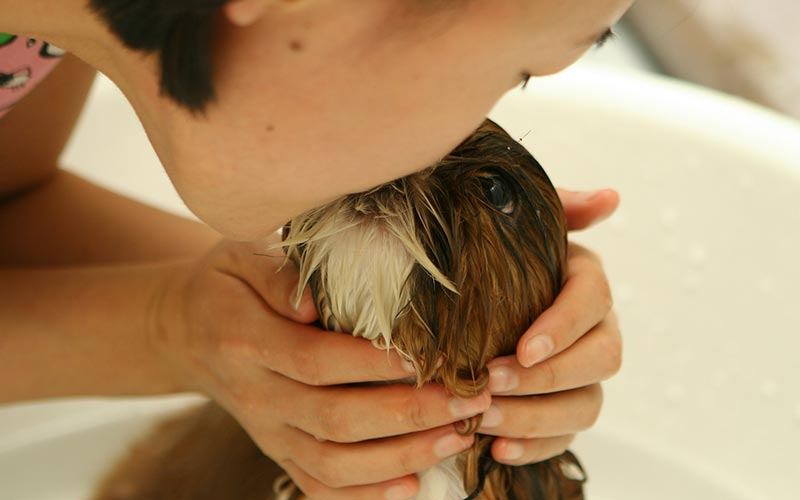
Your veterinarian has probably advised you not to let your dog lick you on your face or the family. They claim there may be parasites, and bacteria present in the saliva. Recent research has indicated dogs licking can heal wounds.
Is pet saliva a health hazard or a healing benefit? The answer is both according to Pet MD. Most veterinarians will state now that your dog licking you is not a major family risk.
A dog's mouth and intestines can carry bacteria and parasites that can be transmitted to humans. These pathogens can cause all sorts of problems with humans. The term known for transmitting pathogens from animals to humans is called zoonotic.
Bacteria:
Pasteurella is a common bacteria in the mouths of cats and dogs. This bacterium can cause skin, lymph nodes, and sometimes more severe. Bartonella Hensel is transmitted to cats from infected fleas. The bacterium is known to create severe skin and lymph node irritants which is also known as cat-scratch-fever.
Salmonella, E. Coli, Clostridia, and Campylobacter are all bacteria that are usually in your pet's intestines. These bacteria can be transmitted to your pet's mouth from cleaning themselves. This same bacterium can be transmitted to humans by your dog licking your face.
Parasites:
Pets are a host of parasites of many kinds. Humans contaminated by pet-transmitted parasites cause intestinal problems, skin problems, and blindness. Pets can live with parasites in their bodies and not show any signs of illness. How your pet can transmit these parasites is when your pet cleans their anus or eat feces and then lick humans, is one form of transmitting.
Giardia and Cryptosporidia are infectious and can easily be contracted by a dog licking another person.
After talking about germs and parasites, there are some benefits in pet saliva for us. Our dogs licking our faces dates back as far as the Egyptian era. Later an old saying from France says "A Dog's tongue is a Doctor, tongue." Lately, research has discovered some benefits in a dog's saliva that aid in healing.
Researchers in the Netherlands have discovered a chemical in pet saliva called statins histatins. Histatin speeds up wound healing by spreading and migrating new skin cells.
Dr. Nigel Benjamin of the London School of Medicine has shown that when saliva has made contact with the skin, it produces nitric oxide which inhibits bacteria growth and protects the wound from infection.
Researchers at the University of Florida have isolated a protein called Nerve Growth Factor that can heal a wound in half the time.
The pet saliva has health benefits for healing our wounds but having your pet lick your face can help spread bacteria and parasites if you are not keeping your pet hygienic at its best.